

 Current position > News detail
『Ultrasonic Flow Meter Doppler: Non-Invasive Acoustic Frequency Shift Probes』Related information(v cone flow meter|rotary gas meter|gallon meter|gear meter|metal tube rotameter|glass tube rotameter|nutating disk meter|transit time ultrasonic flow meter|wedge flow meter|pd meters|hydraulic flow meter|ultrasonic water flow meter|water flow meter|air flow meter|magnetic water flow meter|oxygen flow meter|gas flow meter|argon flow meter|air velocity meter|gasoline flow meter|fuel flow meter|ultrasonic water meter|digital water meter|nitrogen flow meter|solid flow meter|Oxygen tank flow meter|digital water flow meter|diesel fuel flow meter|steam flow meter|02 flow meter|compressed air flow meter|oil flow meter|liquid flow meter)
Ultrasonic Flow Meter Doppler: Non-Invasive Acoustic Frequency Shift Probes for Dirty Liquids
Quick Answer: A Doppler ultrasonic flow meter uses non-invasive acoustic frequency shift probes to measure flow from particles or bubbles moving inside a pipe. It clamps onto the outside of the pipe, so there is no process contact and no pipe cutting. Silver Automation Instruments supplies Doppler flow meters for wastewater, sludge, slurry, and mining flows in pipe sizes from DN15 to DN6000.
How Doppler Acoustic Frequency Shift Works
A Doppler probe sends a known ultrasonic frequency through the pipe wall into the liquid. Suspended particles or entrained bubbles move with the flow and reflect part of the signal back. The return frequency shifts in proportion to velocity. The transmitter reads the difference between the sent and received frequency and converts it into flow rate.
No sensor part touches the liquid. That matters for abrasive slurry, raw sewage, and fluids that damage impellers or electrodes. The probe is installed from the outside of the pipe. There is no shutdown and no flange work.
Probe frequency is selected for pipe material and wall thickness. Silver Instruments uses 0.5 MHz, 1 MHz, and 2 MHz probes. Lower frequencies penetrate concrete-lined or thick pipes. Higher frequencies work better on smaller pipes.
Where Doppler Flow Meters Work Well
Doppler flow meters need a minimum level of suspended solids or gas bubbles. A common field guideline is 100 mg/L or more of particles above 100 microns. If the liquid is too clean, the ultrasonic signal has nothing to reflect from and the meter will not read flow.
Typical applications include raw wastewater, activated sludge, mine tailings, dredge slurry, bentonite, paper stock, palm oil sludge, and river water with silt. A treatment plant in Vietnam installed one Doppler meter on a DN300 return sludge line. The maintenance team mounted the sensors in about 40 minutes without draining the pipe.
Doppler is not the right choice for clean water, demineralized water, diesel fuel, or most finished water lines. For those liquids, Silver Instruments recommends a transit time clamp-on ultrasonic flow meter instead.
Installation and Sensor Mounting
Most engineers skip the mechanical work because clamp-on installation is fast. In practice, pipe surface preparation takes more time than sensor mounting. You prepare the pipe surface, apply coupling gel, and strap the sensor set in place. The transmitter needs a straight run of 10 pipe diameters upstream and 5 diameters downstream. Do not mount on top of a horizontal pipe if the line runs partially full.
Pipe material matters for signal quality. Stainless steel, carbon steel, ductile iron, PVC, HDPE, and lined pipe can work. But pipe condition still matters. Heavy scale or air pockets under the sensor will reduce signal. Set the transmitter for pipe outer diameter, wall thickness, and liquid type.
Because the probe sits outside the pipe, line pressure does not drive sensor selection. A DN50 PVC line and a DN400 carbon steel slurry line can use the same meter type with different sensor sizes.
Outputs and Automation Integration
Silver Instruments supplies Doppler flow meters with 4-20 mA, HART, pulse, and RS485 Modbus outputs. The stand
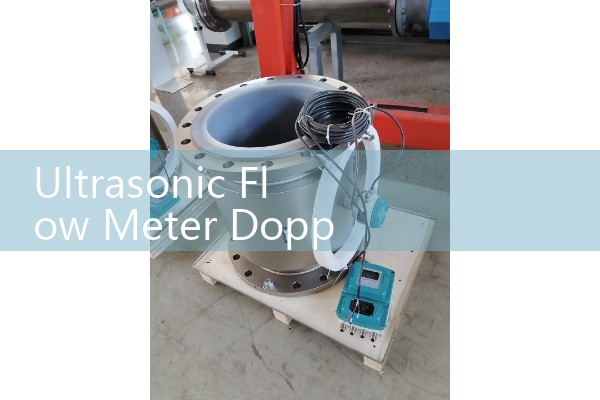
A mining contractor in Western Australia put a clamp-on Doppler meter on a DN200 tailings line with 8 percent solids. The meter sent 4-20 mA to a plant PLC. Field checks showed readings within 1 percent of a magnetic flow meter used earlier on the same line.
Liquid conductivity in µS/cm and viscosity in cP do not change the Doppler measurement. If the site works in kg/h, the transmitter can use a fixed density value for display and totalizer. For hazardous areas, request an ATEX Zone 1 rated transmitter and sensor set.
Doppler vs Transit Time Flow Meters
Here is the thing. A Doppler meter is a tool for dirty liquids. A transit time meter is a tool for clean liquids. Transit time sensors measure the time difference of ultrasonic signals traveling with and against flow. They need clean flow or only small amounts of bubbles.
Use Doppler for sludge, slurry, dredging, mining, and wastewater. Use transit time for potable water, cooling water, chemicals, and clean oil. If the fluid changes between clean and dirty, share the full range before you order.
Sizing Parameters and Recommendations
Most Doppler transmitters read flow velocities from 0.03 m/s to 12 m/s. To quote a Doppler flow meter, we need pipe size, pipe material, wall thickness, liquid type, solids content or bubble level, flow range, and required output. A typical sewage plant request gives us DN250 carbon steel with 6 mm wall, activated sludge, 0.5 to 3.0 m/s flow velocity, 4-20 mA plus RS485 Modbus.
Small pipes from DN15 to DN50 use a compact sensor pair. Standard pipes from DN50 to DN300 use a medium frequency sensor set. Large pipes above DN300 use a low frequency sensor set. The display can show cubic meters per hour, liters per minute, or gallons per minute.
Frequently Asked Questions
What liquids can a Doppler flow meter measure? It measures liquids with suspended solids or gas bubbles. Common examples are wastewater, sludge, slurry, dredge flow, paper stock, and river water with silt.
What is the minimum solids or bubble content? A typical field guideline is 100 mg/L or more of particles above 100 microns. If the flow is too clean, the meter cannot receive a stable Doppler signal.
Does the Doppler flow meter require pipe cutting? No. The sensors clamp on the outside of the pipe. There is no process contact and no shutdown for installation.
Can a Doppler meter measure clean water? No. Clean water has no particles or bubbles to reflect the signal. A transit time ultrasonic flow meter is the correct choice for clean water.
What output signals can Silver Instruments provide? We supply 4-20 mA, HART, pulse, and RS485 Modbus outputs. Optional PT100 temperature input and ATEX Zone 1 certification are available.
Request a Doppler Flow Meter Quotation
Send us your pipe size (DN), pipe material, wall thickness, liquid type, solids content, pressure (bar), temperature (°C), and flow range. Contact Silver Automation Instruments at +86-25-68650347, WhatsApp +86-25-52155837, or WeChat +86 15365082610. Visit flow-meter.com.au for clamp-on ultrasonic flow meter technical data.